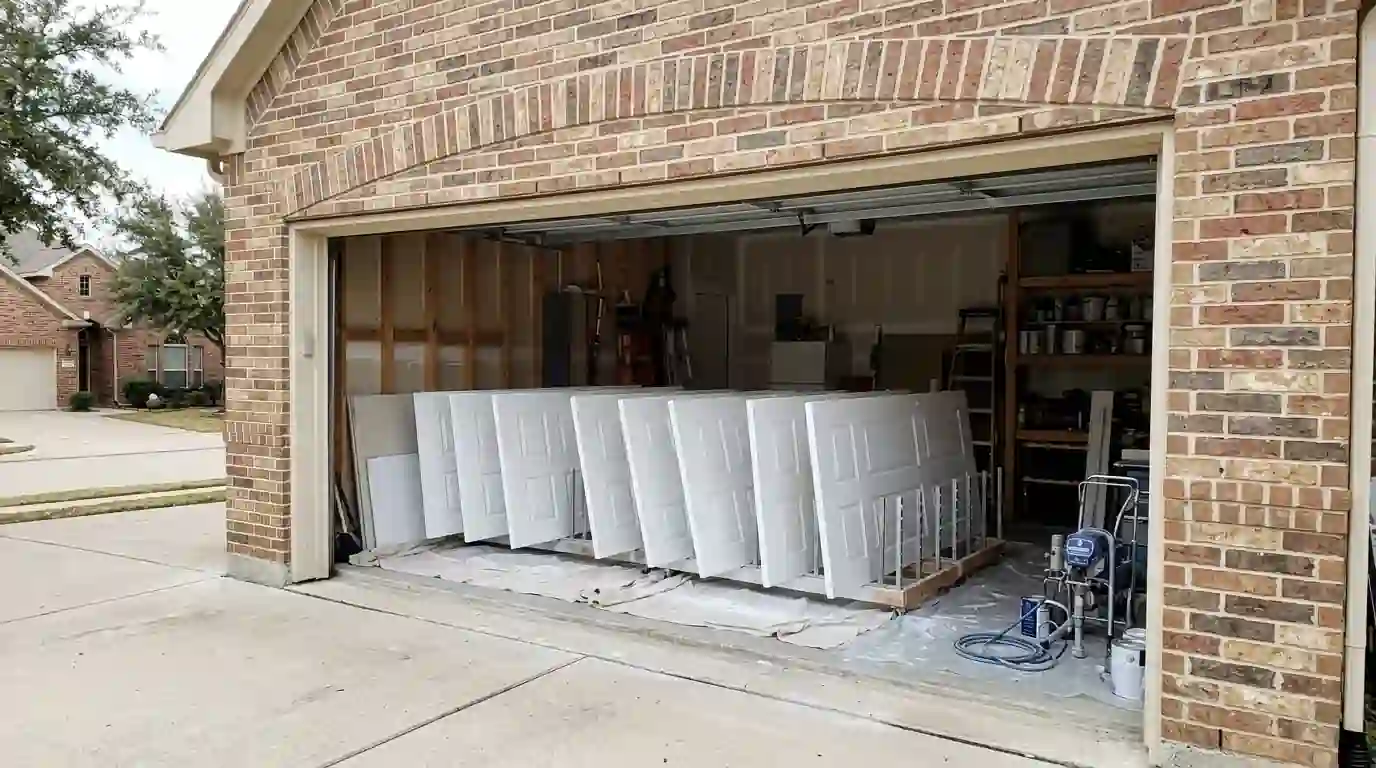
Why all six sides of a door get painted
A door has two faces and four edges, and the top and bottom edges are the ones people forget. Leaving them bare lets the door absorb humidity unevenly, which can lead to swelling and warping over time, especially on hollow-core doors with thin veneers. When we have doors off the hinges, every edge gets sealed. When doors stay hung, we still paint the latch and hinge edges and reach the top edge from a ladder. Edges also need a slightly lighter coat than faces. Heavy paint on the latch edge or hinge edge is what makes a door rub against the jamb or stick to the stop in humid weather.
Spraying off site or brushing in place?
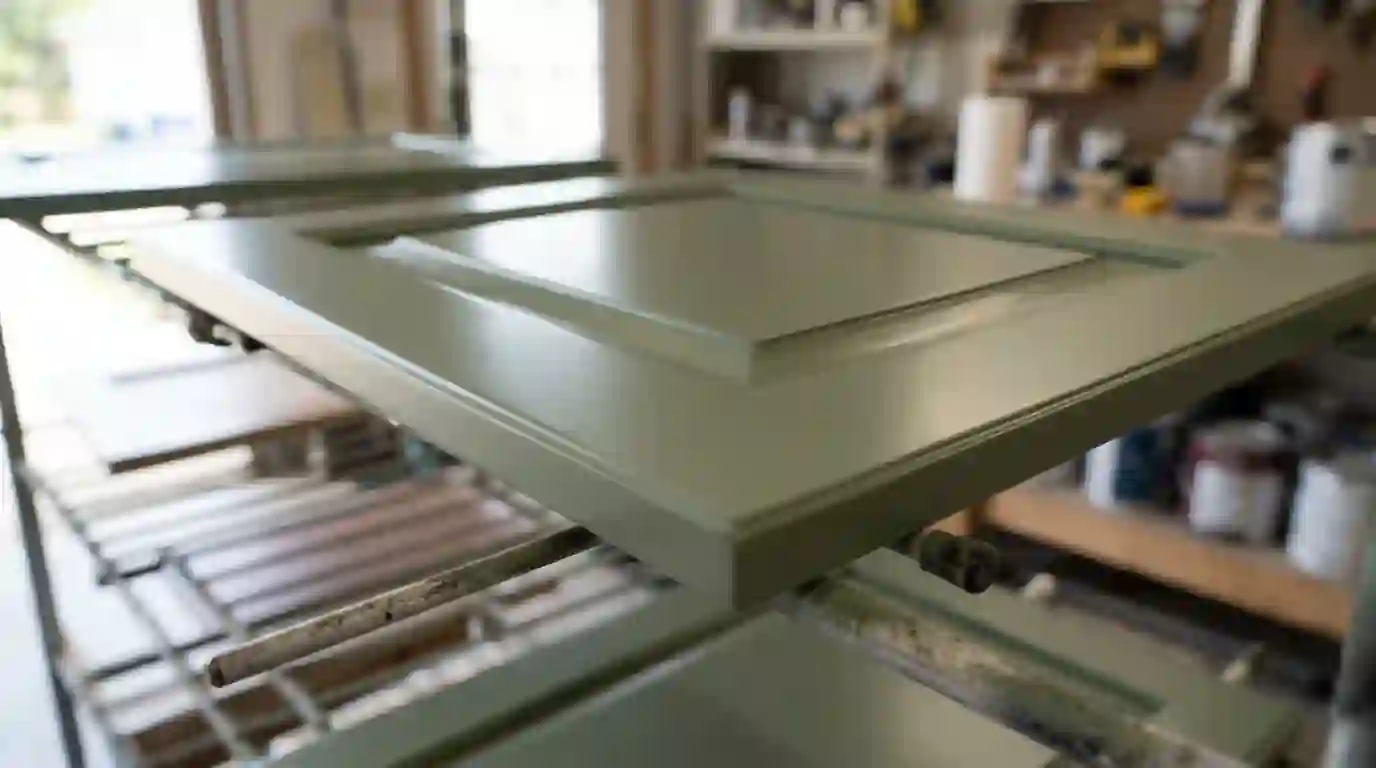
Both work, and the choice depends on your doors and how many there are. For a full house of six-panel doors, we often pull the slabs, label each to its opening, and spray them in a controlled setup. Spraying gives a near-factory finish with no brush marks in the panel bevels. The jambs and casings are brushed in place while the doors are out. For one or two doors, or when you'd rather not have openings without doors overnight, we brush and roll in place with a fine foam or microfiber roller on flat areas and a quality brush in the panel profiles.
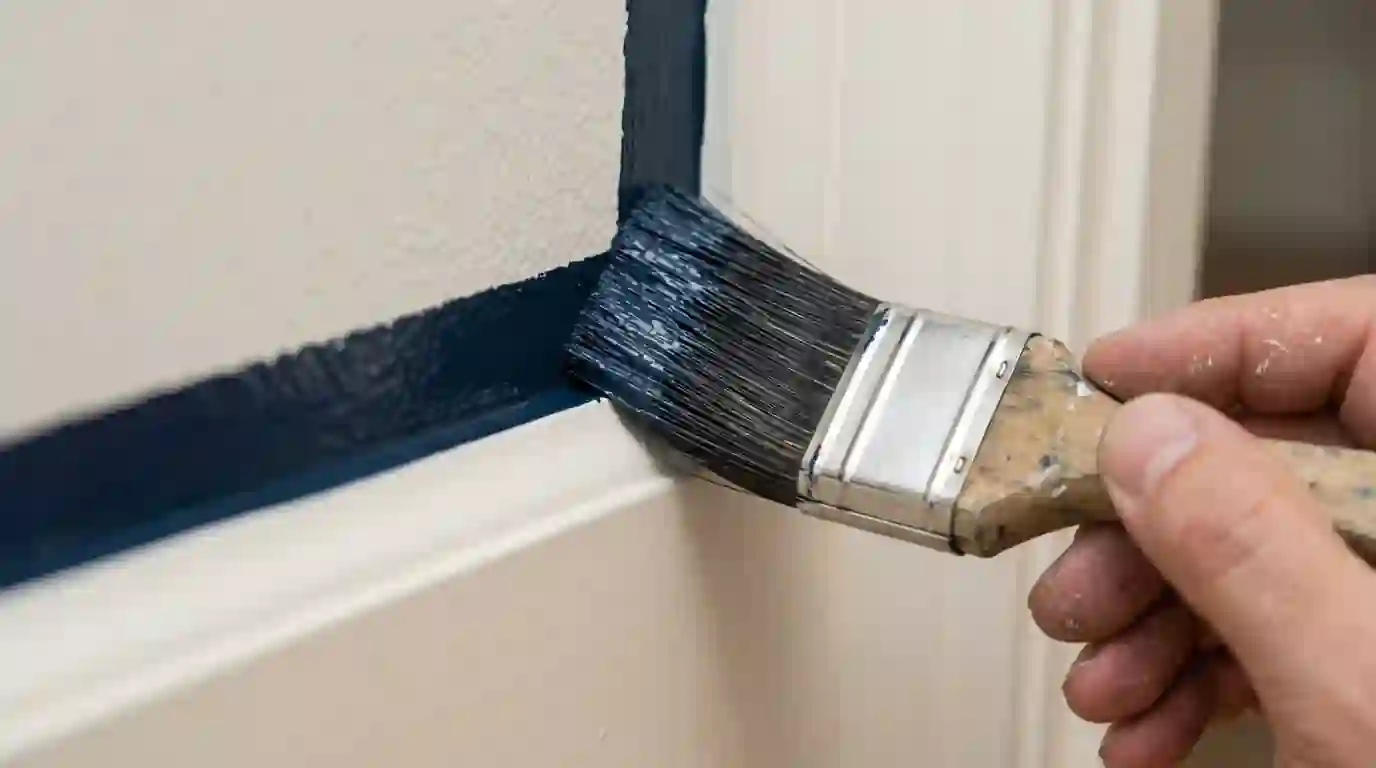
Either way, we follow the panel door sequence: panel insets first, then the center stiles, rails, outer stiles and finally the edges, so brushed areas overlap in the direction a woodworker would expect. That order keeps brush marks running with the grain of each part instead of across a joint. On flush slab doors there are no panels, so we roll the face in one continuous pass and lay it off lightly with a brush or foam roller for an even texture.
- Spray off site: smoothest finish, best for many doors
- Brush and roll in place: fewer disruptions, good for a few doors
- Jambs and casings are always finished in place
What interior door painting typically costs in Fort Worth
$145 to $265
per door, both faces and edges, with jamb and casing, when six or more are done together. Your price comes from a written scope after we see the job.
What moves the number
- Six-panel versus flush slab style
- Removing doors to spray off site
- Dark-to-white or stained-to-painted change
- Bifold, French and louvered doors
- Hardware swap and new hole drilling
- Number of doors in the project
Stopping the sticky door problem
Fresh acrylic enamel can stay slightly tacky for days, a quality painters call blocking resistance. If a door closes against its stop before the paint hardens, the two surfaces can bond and peel when opened. We use enamels rated for good block resistance, apply thin coats, and leave doors propped slightly open for the first day. Where a door has been sticking because of years of paint buildup on the stop and jamb, we scrape and sand those surfaces down before painting rather than adding another layer.
Hollow-core, solid-core and older wood doors
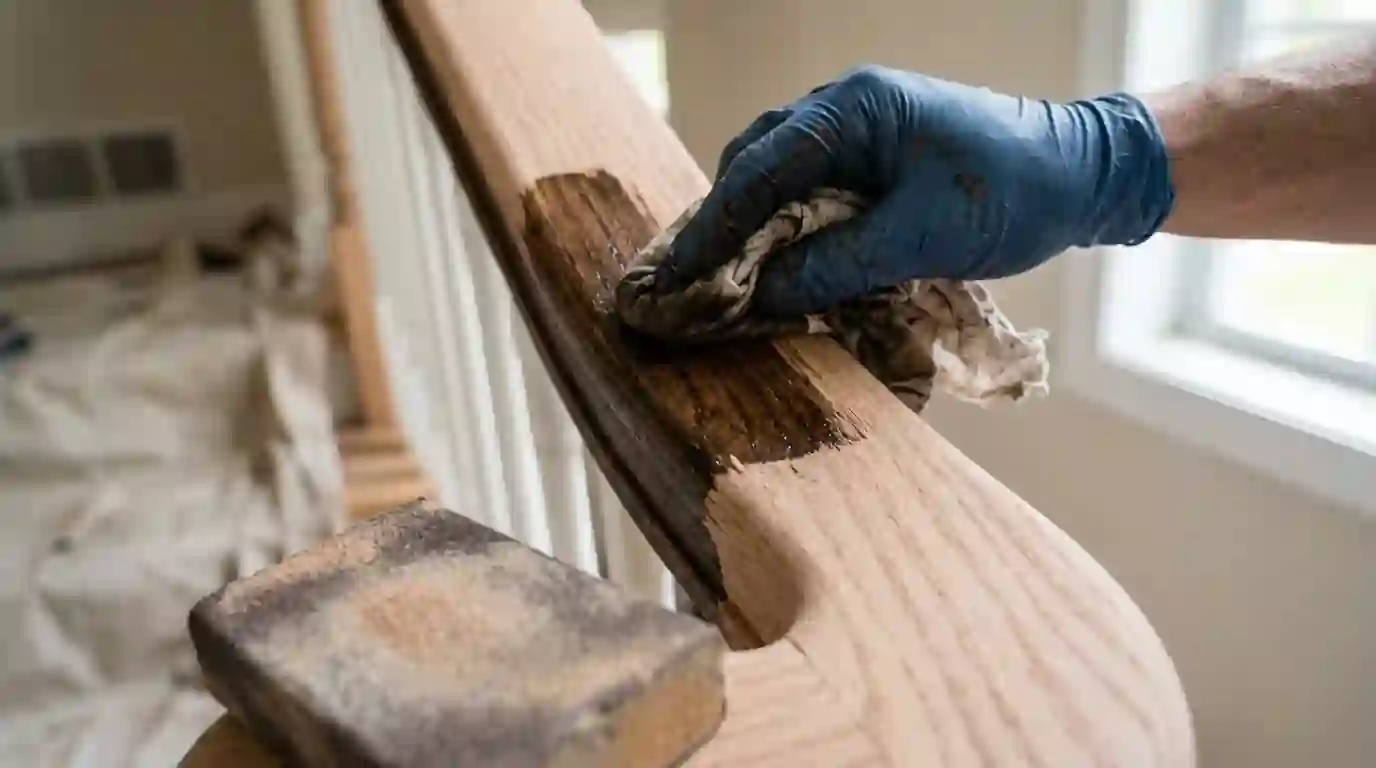
Builder-grade hollow-core doors in many Fort Worth subdivisions have a pressed hardboard skin with a simulated wood grain. They take paint well after a scuff sand and a good bonding primer, but dents can't be sanded out deeply, so we fill them with a two-part filler where needed. Solid-core doors in newer custom homes are heavier and smoother. In older Craftsman bungalows near Fairmount or Ryan Place, original five-panel fir doors often carry decades of paint, and in pre-1978 homes those layers may contain lead, which changes how we sand and clean up. On stained doors switching to paint, a shellac-based primer stops the wood tannins from bleeding through white enamel.
Hardware, hinges and the finishing details
We remove knobs, levers and strike plates rather than taping around them, because paint lines on a knob rose look sloppy and taped edges often lift. Hinges are either removed or carefully masked, and we don't paint them unless you ask. If you're switching to new levers or matte black hinges at the same time, we coordinate so the new hardware goes on after the enamel hardens. Door stops and hinge pin stops are reinstalled so the fresh paint on your walls isn't the first thing a door handle hits.
Signs it is time for interior door painting
- Gray handprints around knobs that come back right after cleaning
- Chipped paint along the latch edge and near the bottom rail
- Doors that stick to the stop because of thick old paint
- Painted-over hinges and knob roses from a previous sloppy job
- Stained hollow-core doors that look dated next to updated walls
- Bedroom doors showing pet scratches near the floor
How we handle interior door painting, step by step
- 1
Count and label
We count every door, note its style and condition, label each slab to its opening if removing them, and confirm color and sheen for doors, jambs and casings.
- 2
Remove hardware
Knobs, levers, strike plates and stops come off and are bagged per door, and hinges are removed or masked depending on whether the slab is coming off.
- 3
Clean and sand
Grime around handles is washed off with a degreasing cleaner, then faces and edges are scuff sanded and dents or scratches are filled and sanded flush.
- 4
Prime the problem areas
Bare wood, filler, stained surfaces and any glossy oil enamel get a bonding or shellac-based primer, which is lightly sanded once dry to leave a smooth base.
- 5
Apply two enamel coats
Doors are sprayed or brushed and rolled in the correct panel sequence, with thin coats on edges so the door still closes freely in its frame.
- 6
Rehang and test
Hardware is reinstalled, doors are rehung on their original openings, latching is tested and each door is left slightly open while the enamel finishes hardening.
Fort Worth conditions that shape interior door painting
Fort Worth homes see door trouble that traces back to the slab. When clay soil under the foundation dries and shrinks during a hot summer, door frames can rack slightly out of square, and doors start rubbing at the top corner or failing to latch. A fresh coat of paint won't fix that, and extra paint makes it worse, so we check the swing and reveal of every door before painting and point out frames that need adjusting. Humid weeks during spring storm season make thick paint on edges stickier, which is why we keep edge coats thin. Garage entry doors that face a hot garage also need an enamel that stays firm in heat, since summer garage temperatures here can soften soft finishes.
Where we offer interior door painting around Fort Worth
Across Fort Worth (76102 and surrounding ZIP codes), including Fairmount, Ryan Place, Mistletoe Heights, Arlington Heights, Tanglewood, Westcliff and other neighborhoods, plus these nearby cities and counties:
- Arlington 76010
- Grand Prairie 75050
- North Richland Hills 76180
- Mansfield 76063
- Euless 76039
- Grapevine 76051
- Bedford 76021
- Keller 76248
- Burleson 76028
- Haltom City 76117
- Hurst 76053
- Southlake 76092
- Weatherford 76086
- Saginaw 76179
- Colleyville 76034
- Benbrook 76126
- Tarrant County 76102
- Denton County 76201
- Johnson County 76031
- Parker County 76086